
The Skin Protocol – The Algorithm Sewn into Fibres, Brand Stigma, and the Tactical Costume
The Algorithm Sewn into Fibres, Brand Stigma, and the Tactical Costume
Section: The Case Study
Date:03 March 2026
Filed under: Emotional Economics / The Lingerie Drawer
The Brief
The moment you spot a system glitch usually occurs on an ordinary street. That day, my algorithm precisely fed me a seasonal campaign from a lingerie brand I had previously purchased. I casually handed my phone to the man beside me, asking him about the emotions and focal points of men when viewing such adverts. His answer was not about the product; instead, he casually mentioned that he had recently been bombarded with Sydney Sweeney's lingerie adverts, with the comment section swarming with men paying for them - yet that advert had never once appeared on my feed.
We are no longer auditing the merits of lace versus cotton, but rather how capital peddles "Organic Autonomy" to women on the front end, whilst commodifying it as a sexual totem to men on the back end. In this dual-harvesting system, the only way to reclaim power is through an intensely cold-blooded sensory and psychological inventory segmentation.
Dimension 1: The Dual Market and the 'White Male Cop' in the Panopticon
That street-side conversation exposed the dual ledger of modern consumerism. During front-end PR, brands preach "sartorial freedom" to lower the moral friction for female buyers and supposedly eliminate the male gaze; yet the algorithm honestly pours the budget into the conversion funnel of the male gaze on the back end. What male consumers purchase is not a garment, but an intangible relic. In this absurd closed loop, they believe they have purchased the right to objectify, but in reality, they have merely been reduced to precisely harvested inventory within the algorithm's echo chamber. The brand utilises a Visual Code to successfully hijack desires from both sides, while the true master remains the capital engine operating in the background.
For women, the projection of lingerie triggers a vastly more complex, multi-layered emotion. Under the rule of this Visual Code, we face the strangulation of multiple gazes. The first layer is the patriarchal shame: educated by mothers under a patriarchal society, we are told that wearing such garments contradicts the societal expectation of a "good girl", and that we must remain demure rather than exposing our desires. The second layer is the internalised objectified perspective: constructed by society, social media, and culture as "passive objects to be looked at", we unconsciously adopt their visual lens to scrutinise ourselves. We self-censor, as if a "white male cop" has taken residence in our minds, constantly auditing us in the manner of a panopticon. The third layer is the so-called "girlfriend gaze" - the peer comparison, anxiety, and jealousy from other women that dictate how we view these products and adverts.
Beyond the gaze, we easily fall into the trap of objectification and self-objectification. When social media and algorithms repeatedly push narratives and images that deliberately weaken female subjectivity, we often surrender our right to question. Drifting with the current is always effortless; it saves you from standing alone to challenge the consensus. Yet, when we exist in an environment steeped in "objectification", we begin to piece together localised body parts-legs, waists, breasts - evaluating them as mere commodities. In doing so, we internalise this male-centric perspective, turning lingerie from an article of clothing into a verdict on whether we are deemed "immodest" or "shameful".
Dimension 2: Signal Depreciation and the Tactile Recalibration Beyond Brand Stigma
Against the external clamour, we must establish a physical perimeter.
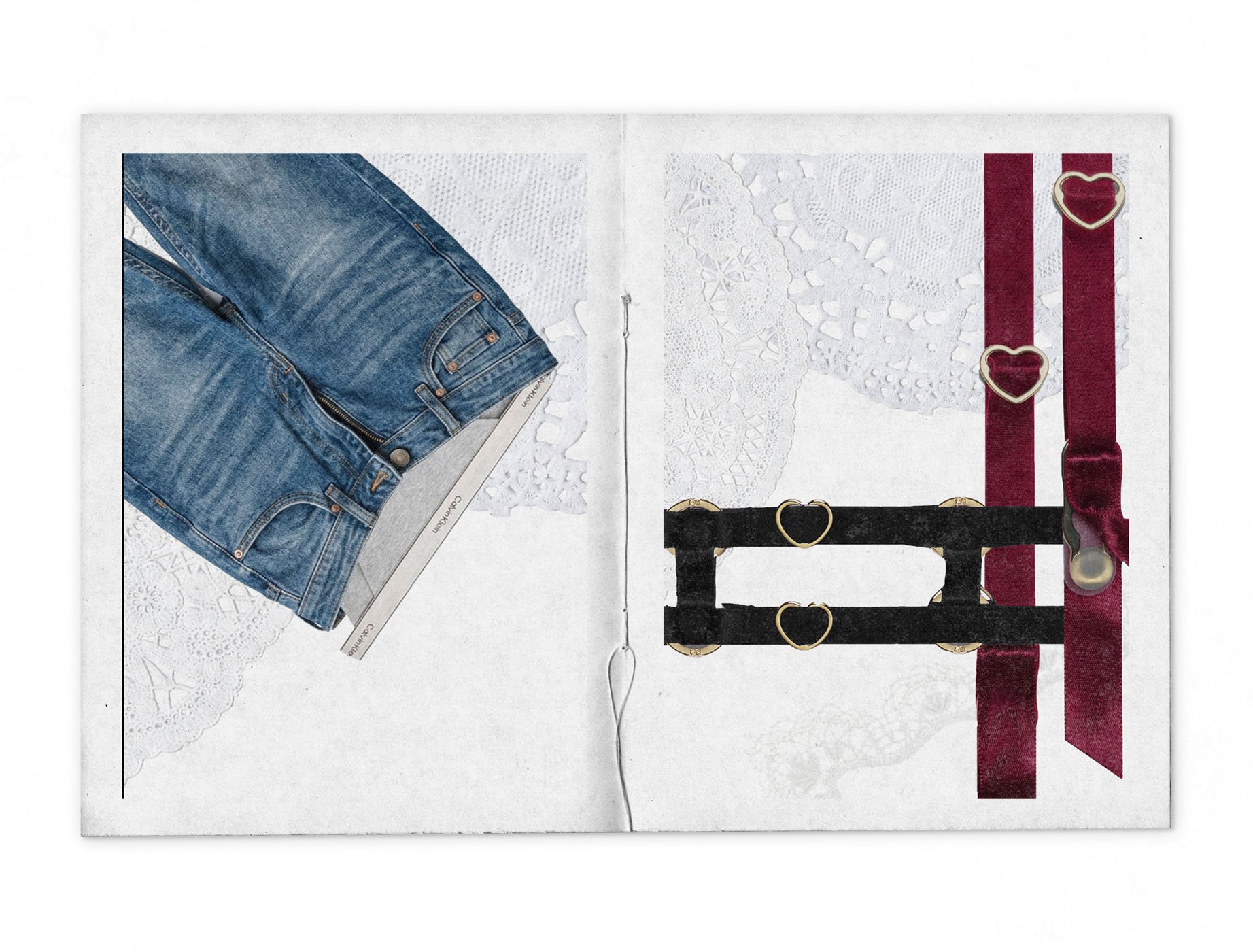
For years, I instinctively rejected garments bearing massive logos. It is a cheap projection of status , resembling a child desperate for attention frantically waving their hands to declare their presence. Just like Burberry in its early years, when its 'chav' check pattern in the 90s and early 00s brought massive exposure but led to severe brand image damage. High-end clients abandoned the brand, refusing to be associated with the working-class or anti-social youth subcultures. Another trend that repulsed me was the 90s sagging subculture, where trousers hung low enough to expose half of a white Calvin Klein waistband. To me, the brand equated to "annoying people who couldn't wear trousers properly".
That was until recently, when the algorithm pushed a CK advert featuring Jennie to me. The clean, black-and-white imagery erased the eroticism and pandering, leaving only a natural sense of ease. Crucially, I discovered they had launched the "Modern Logo" line, shrinking that originally loud, wrap-around emblem into a single, quiet mark.
I stepped back into the physical store and completed a thorough sensory recalibration. It resolved my visual trespass with the shrunken logo, provided extreme comfort through Modal and cotton fabrics, and at a discounted price, it became a perfect acquisition. As a result, I replaced my entire wardrobe with this series - two colours, black and white; simple, comfortable, and lucid.
In our daily physical inventory, we sever external visual demands, refusing to let the brain expend resources monitoring "how beautiful I look", and instead entirely absorb the tactile data of "how comfortable I feel". This is a screening mechanism with zero tolerance for physical friction; only if it is comfortable enough to sleep in does it earn the right to remain.
Have I forgotten the sagging culture? No, but it has upgraded. In 2022, brands like Miu Miu championed the "Peekaboo Underwear" trend alongside the Y2K aesthetic. When I wear my high-waisted CK briefs paired with low-rise jeans, that quietly exposed white band is no longer a crude rebellion. It is a restrained manifesto: In an environment where everyone attempts to discipline you and dictate your milestones, I know it is exposed, and I simply do not care.
Dimension 3: Mimetic Desire and the Lucid "Tactical Costume"
This does not mean we must discard all sexy lingerie; rather, we need to redefine its properties.
Introducing the logic of Enclothed Cognition, those slightly uncomfortable garments, the coarse fabrics, the underwiring pressing against the ribs - these are tactical utilities used to mount a specific psychological programme. We are fully aware that we are performing; we actively don this costume to boot up a mental state of confidence or power, thereby seizing control of the interaction's dynamic.
In the sociological framework of symbolic interactionism, our cognition is built upon the feedback of others. When we are bombarded by precise lingerie adverts on social media, René Girard's "Mimetic Desire" begins to run its course. We do not know what we truly want; our desires are fundamentally imitated. You might unconsciously see a film's heroine secure the perfect man whilst wearing a black lace set, and your 'looking-glass self' begins to mimic, convincing you that only by owning this garment can you draw closer to that perfection.
If we cannot distinguish whether a purchase serves our authentic self or the perceived judgement of others, we risk falling into severe introjection, potentially developing a false self.
Of course, I am not telling you that lingerie is a heinous product. I merely ask that when you are about to purchase a new piece, pause and ask yourself: is this decision serving me, or is it catering to a specific demographic? If it is the former, the purchase is loyal. As long as you know, from the bottom of your heart, what prop it plays in your script, a lucid cognition ensures you always know how to maximise their utility, rather than being utilised by them.
The Takeaway / The Verdict
Keep: Maintain absolute loyalty to tactile data. Listen to your body's feedback, employing "comfort" as the ultimate veto for your daily inventory. Concurrently, retain your curiosity and lucidity, confronting your own desires honestly.
Let Go: Abandon the blind anxiety surrounding the "male gaze" and objectification, and relinquish the habit of enduring prolonged physical discomfort to cater to visuals. Acknowledge the utility of lingerie as a tool - let it serve you, rather than you serving it.
Look Elsewhere: Extend the test of sensory recalibration to your dressing table. Gaze at the lipstick you habitually apply before leaving the house, or that specific bottle of perfume, and audit them: are they there to establish your absolute territory in a physical space, or merely to conceal your hidden insecurities towards the surrounding environment?
R. tobekeep
