
The Pieces of Paper with Eyes
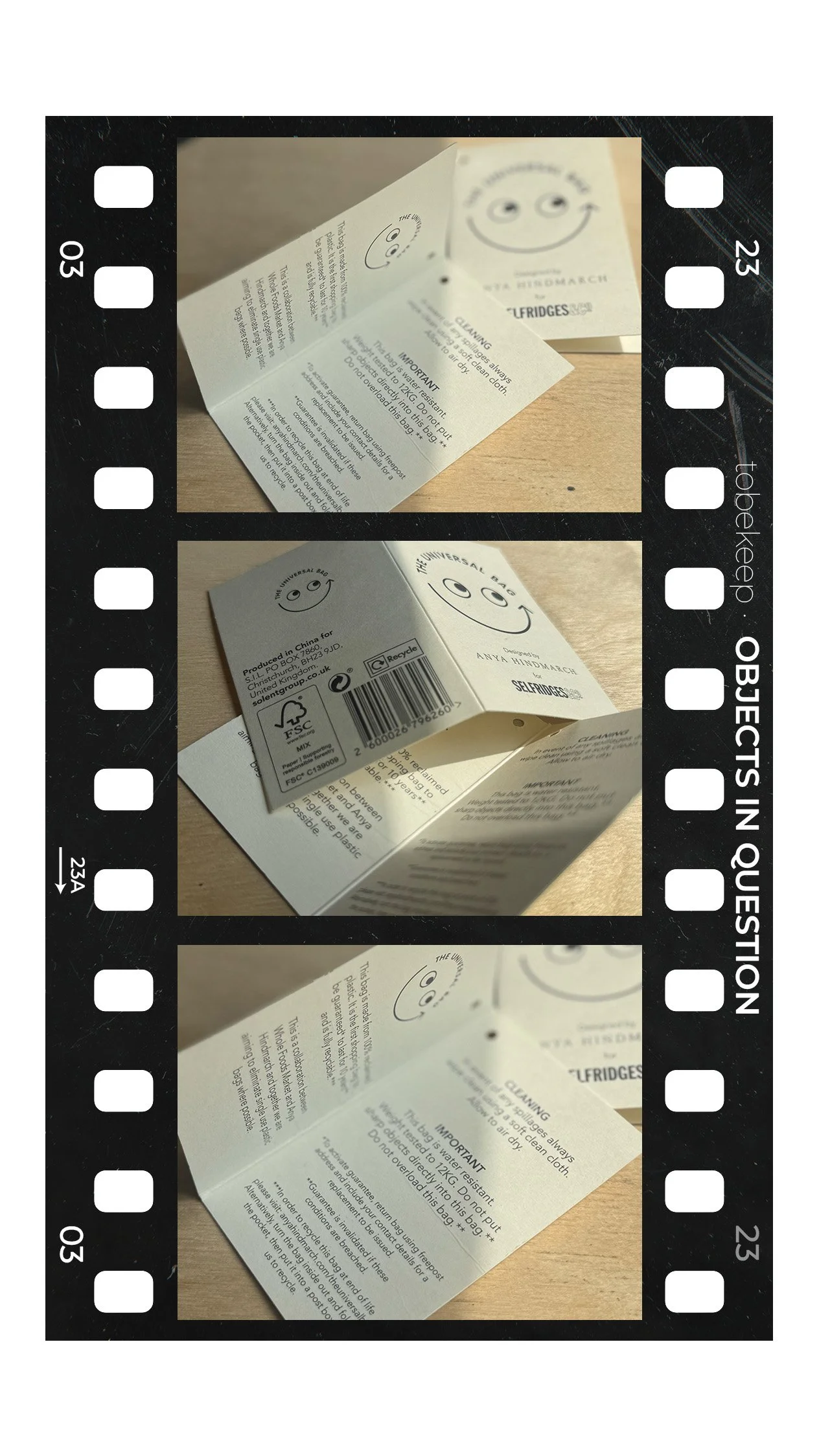
How a tag that had already finished its work avoided the paper recycling.
Objects: Anya Hindmarch The Universal Bag tags
Filed under: Paper · Anthropomorphism · Classification · Attention
At home, there is a Muji uncoloured polypropylene box filled with cards removed from clothes and other objects. They have never been filed individually. They have simply accumulated with each purchase: Lululemon clothing labels, branded swing tags, and scraps of paper I did not happen to throw away at the time.
I do not usually open the box on purpose. The stack reappears only when the clutter around it has built up to the point where it can no longer be ignored and the entire drawer has to be sorted at once.
Several tags from Anya Hindmarch’s The Universal Bag are in there too. They were originally tied to the bag straps with thin white cord: square cards, folded in half. The paper, dimensions and design are almost identical. On the front is a face made from two eyes and a curved line, with the words Designed by Anya Hindmarch for… printed beneath. Only the name of the collaborator changes: Selfridges, Daylesford, Whole Foods, or another brand.
Unless I lower my eyes to read the small print, I cannot tell which card came from which bag.
There is no longer any information on them that needs to be kept. The bags do not rely on the cards for washing instructions, nor do the tags preserve the price, dimensions or method of use. The collaborator’s name can identify the source, but not enough to form a genuinely useful record of purchase. Once a tag has been removed from the strap, its work as a label is already complete.
I still have not thrown them away, though this was never a particularly clear decision. I did not pause to consider whether they were worth collecting, nor did I find them a dedicated place. I simply removed the cord, placed the cards in the drawer, and stacked them among the other clothing labels.
Their journey into the box was no different from that of an ordinary Lululemon tag. Perhaps this is only postponement: once a piece of paper enters that box, it temporarily escapes a decision. Ordinary tags sometimes remain there for a long time too, until the next round of sorting brings them back into view.
The real difference appears when an ordinary tag returns to my hand. It usually becomes paper again very quickly. The brand name, size and price are no longer useful, and there is nothing else on its surface worth continuing to inspect. Sending it to the paper recycling is not difficult.
The cards with eyes do not change back quite so easily.
The eyes do not look directly at the person holding the card. Their pupils are turned to one side, as though something nearby has caught their attention. I do not feel that they are watching me. It is closer to this: I am looking at them, while they remain occupied with looking elsewhere.
Because of that tiny shift in direction, what began as a piece of paper printed with a brand name begins to seem faintly occupied with something of its own. It remains flat and still, yet no longer feels entirely like a surface waiting only to be read and processed.
The same eyes alter the bag itself. The bag does not truly acquire an expression, and once carried, the eyes are often partly covered by my arm. Yet it no longer appears to be merely a container made of fabric, straps and capacity.
Those eyes, turned away from me, make it look as though it has an attention of its own.
It is not a complicated design. Two eyes and a curved line add no information to the card and improve none of the paper’s functions. Yet they make it harder to treat as a piece of material whose purpose has already ended.
I once considered cutting out the eyes and keeping only the part I genuinely liked, but quickly realised that this would solve nothing. I would merely move the image from one piece of paper to another while destroying the card’s original form.
The eyes are not information that can be extracted on their own. Together with the folded paper, the curved mouth and the collaborator’s name beneath, they form a small face.
And so the cards remain intact in the box.
I do not deliberately take them out to look at them, nor can I remember which one belongs to which collaboration without reading the name. They are not displayed, they play no part in daily use, and they reappear only briefly when the entire drawer needs sorting.
By the standards of collecting, this is a remarkably loose form of keeping. I have made no list, arranged nothing by collaboration, and given them no place from which to be seen. If collecting requires active seeking, ordering and display, then these cards have received none of that attention.
Yet at the end of every round of sorting, they are still there among the paper.
A tag usually proves its continued usefulness through information: material, price, washing instructions, or the origin of the object. Once that information is no longer needed, the reason for keeping it disappears as well. These cards, however, entered another state after their information expired.
They are still paper, but no longer entirely waste paper. They resemble a collection, though they are almost never looked at. I did not keep a particular card because I remembered a particular bag. In fact, without reading the name at the bottom, I cannot tell them apart.
What has been kept is neither the source nor the information.
Each time I sort the drawer, an ordinary tag can return to being a piece of paper whose work is finished. These cards are still seen first as several small faces.
Their work as labels ended long ago, but they have still not quite become waste paper again.
-
There was an unexpected moment while I was arranging the photographs for this essay.
Until then, the tag had always been recognised in the same order: first as a pair of eyes, and only afterwards as a piece of paper. Preparing the images required looking at it differently. The photograph had to show the object itself, not only what it had come to mean.
Only then did the words begin to emerge.
The tag had never simply been attached to a shopping bag. It described an entire system. The bag was made from recycled plastic, guaranteed for ten years under specific conditions, and designed to be returned to the manufacturer once its working life was over. Even the side of the bag quietly illustrated the cycle: use, fold, post, repeat.
None of this information had changed. It had always been there.
What changed was the order in which it was read.
For years, the eyes arrived before the instructions. The paper had already become a face long before it was allowed to become information. By the time I finally read the text properly, the relationship had already formed elsewhere.
The discovery did not contradict the original observation. If anything, it sharpened it. The designers had carefully constructed a story about durability, responsibility and circular use. Yet what survived in memory was neither the guarantee nor the recycling process, but a pair of illustrated eyes.
Nothing about the label had changed over the years. Only the reader had.
Perhaps that is how objects quietly change without changing at all. Their meanings do not remain inside the paper, the ink or the instructions. They move with whoever is reading them, and with the life that has accumulated around them.
