
The Bag That Carries Every Day
How a backpack bought for business trips reduced the number of decisions in an ordinary working day.
Objects: Lululemon backpacks, large and small
Filed under: Carrying · Capacity · Anticipation · Repetition
I often joke that it could carry the whole world.
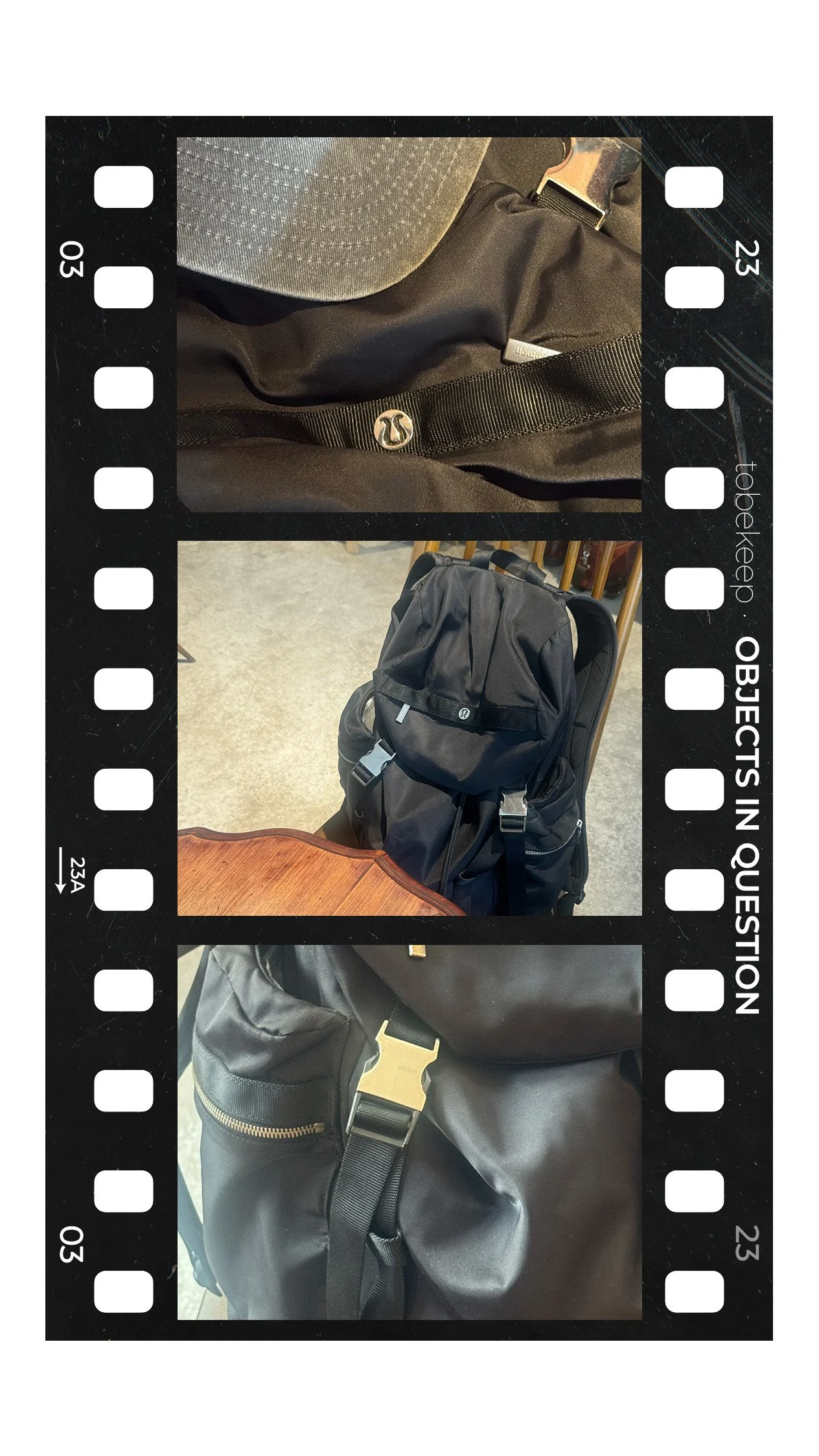
It began as nothing more than a backpack I bought for business trips. All black, with silver hardware, three compartments and four pockets, it looked large, almost like a hiking pack, with no bright colours and no obvious branding.
The reason I bought it was simple: it would make flying easier. My laptop, charger, documents, passport, headphones, water bottle, jacket, and all the small things I probably would not need but would feel uneasy leaving behind could fit inside. I assumed it would only appear when I travelled.
Instead, it became the bag I carried to work every day.
Of all the bags I own, it gradually became the one I reached for most often. The laptop, water bottle and umbrella each had their own place, yet there was still a wide stretch of empty space left in the middle. On my way home, fruit, vegetables, meat and drinks could simply be dropped in as well.
Every time I packed that day’s shopping into it, item by item, my colleague would look at the bag and laugh.
“That bag could carry the whole world.”
Eventually, he bought the same one.
The strange thing is that it has never felt like the bag that represents me best. It is understated, ordinary, even slightly student-like. Working in fashion, I own bags that are objectively more beautiful: leather with visible grain, smooth hardware, careful stitching, brands recognised by those who know without ever needing to announce themselves. They are better suited to entering a room, and much closer to the sort of bags I once imagined I would spend years carrying.
This backpack is different. It feels less like a bag for arriving somewhere than a bag for taking everything with me. There was another reason I did not expect to like it: everything sits behind my back.
I have always preferred bags I can touch with one hand and glance at without thinking, quietly reassuring myself that the important things are still there. A backpack was never a style that naturally made me feel secure.
Later, I even bought the smaller version from the same range. I imagined the large black one would remain my work and travel bag, while the smaller one would suit ordinary days out. It was lighter, less conspicuous and less likely to make me look as though I were permanently about to catch a flight. To distinguish it from the first one, I chose it in blue, a colour I genuinely liked.
In theory, it should have suited me better. Instead, it sat at home for three months before I used it for the first time. The colour was beautiful, but once I packed my dog’s water bottle inside, a considerable amount of space had already disappeared. Add a towel for him, and there was very little room left.
Capacity itself was not what stopped me using it. The real difference hid somewhere much smaller: inside the larger backpack is a zipped pocket just large enough for my cardholder. It sits deep enough that other people cannot easily reach it, yet close enough that I can find it almost instantly by touch. As long as my cardholder is there, I know the most important thing has already been put away.
The smaller version has no such pocket. The space has been replaced by a laptop sleeve. Even the shoulder straps feel different. The smaller bag is lighter, yet somehow always seems to hang slightly away from my body. The larger one is heavier, but that weight allows it to settle comfortably against my back instead.
So what the smaller bag lost was never simply a few litres of capacity.
It lost the place where I stopped checking.
It also lost that section of empty space whose purpose never had to be decided in advance. Even on days when I do not need to carry much, I still like the empty space at the centre of the larger bag. It can take vegetables bought during lunch, a box of fruit, two bottles of something to drink, or a jacket I suddenly no longer want to wear halfway through the day. Because the space is there, I do not have to stand in a shop calculating whether something will fit, how I will carry it home, or whether I will end up with my laptop in one hand and a shopping bag in the other.
That space is rarely assigned to anything in particular beforehand. It simply stays empty.
Only later did I realise that what the larger bag truly reduced was not weight, but judgement.
Each morning, I do not have to predict all over again whether it will rain, whether I will get a headache, or whether my phone or laptop will need charging. The umbrella, painkillers, charging cables and reusable bag remain naturally in their respective places. The laptop goes into the compartment at the back, the cardholder into its concealed zipped pocket, and the smaller things into the sections at the front. Once everything is in, there is still room left in the middle.
Beautiful bags have work of their own. They can complete an outfit, give me more confidence as I enter a particular setting, and allow other people to see something of the taste I am willing to express. But when I use them, I become more cautious. They must not be caught in the rain, filled with a drink that might leak, or casually packed with meat, vegetables and fruit. They make me look more polished, but they also make me more careful.
This backpack does not need me to look after it. In wind and rain, it protects what is inside. Even when full, it never makes me feel that I am asking too much of it. If I return home with the extra food I happened to buy that day, the weight can still be shared across both shoulders.
Each morning, my hand still reaches for it more often. Not because it is the most beautiful, or because it represents me best, but because so much has already been dealt with before I leave the house.
I had imagined the smaller bag as the version better suited to everyday life. It was lighter, prettier and closer to the sizes I was used to carrying. Yet what makes the larger one genuinely useful every day is precisely what first appears excessive: a pocket hidden well enough, a weight that keeps it close to the body, and capacity that has not been occupied in advance.
It was bought for the occasional business trip. Later, I carried it every day to face things that were smaller, more ordinary and harder to know beforehand.
I often joke that it could carry the whole world. More precisely, it carries the part of a working day that has not happened yet.
So when I leave in the morning, I do not have to plan for every version of the day. I only have to put the bag on.
