
Wearable, Not Edible
On a fried egg, a childhood dining table, and the body’s recovered right to refuse
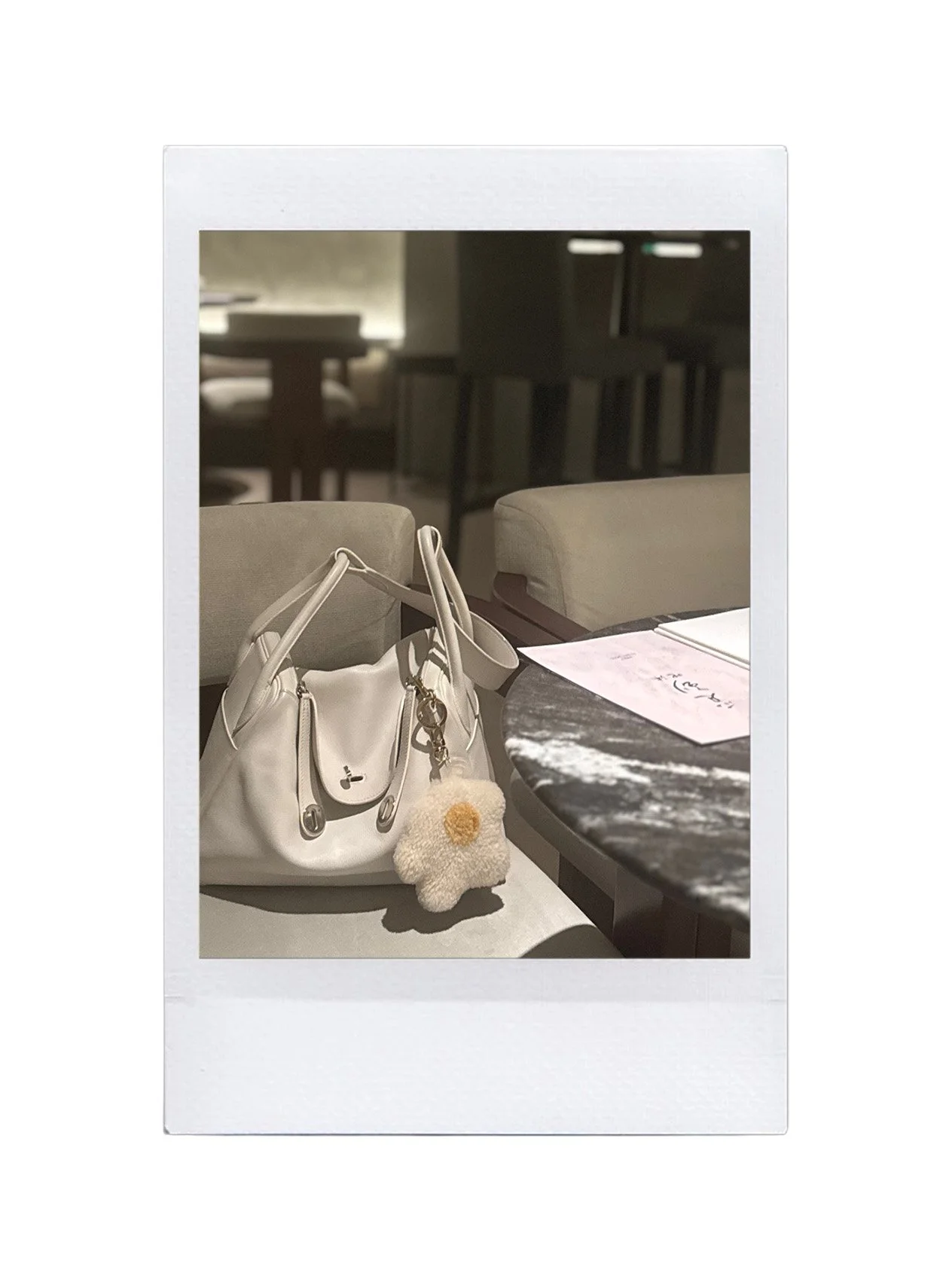
Object: Anya Hindmarch fried-egg charm
Filed under: Food · Texture · Agency · Bodily refusal
Not long ago, I was having brunch with a friend when she began watching the way I dealt with the fried egg on my plate. I slowly cut around the line between the white and the yolk, then carefully pushed the yolk to the edge of the plate. The movement was precise enough to resemble a minor surgical procedure: I was trying to prevent the still-liquid centre from breaking open and running into the rest of the food.
She watched for a moment, then looked up at my bag.
‘Don’t you hate eating eggs? Why have you got such a large fried egg hanging from your bag?’
I followed her gaze. Hanging from the bag was an Anya Hindmarch fried-egg charm; on the plate was an actual egg. They shared the same outline: a yellow yolk surrounded by white, instantly recognisable. Yet sitting between the two, I did not find my behaviour contradictory.
The yolk on my plate was not fully cooked. Its semi-liquid centre produced an immediate tension in my body. The colour was an attractive orange-yellow, but once its surface broke, a glossy liquid would spill out. A fully cooked yolk was no better. It became a pale, dry, crumbling mass that absorbed the moisture from my mouth and took effort to swallow. For me, an egg rarely occupies the right state. It is either too wet or too dry.
The one hanging from my bag was entirely different. Made of wool, its surface was dry, curled and slightly resistant beneath the fingers. The white was not a clean, pure white, but carried a faint grey cast; the yellow centre could not split, flow or collapse. It gave off no warmth or smell, and it would not change state if left for too long. It looked like a fried egg while making it clear from the outset that it was not food.
Perhaps I liked it precisely because it was not too realistic. Had it been made from smooth plastic, with an oily sheen and a yolk that appeared ready to spill, it might have come too close to the real thing. Wool pushed it in the opposite direction. Its slightly grubby, unyielding texture formed a visible boundary, telling the body: there is no need to worry; this will not enter your mouth.
My friend’s question made me look properly at that distinction for the first time. I do not dislike the shape of a fried egg, nor am I disturbed by the image of a yellow circle surrounded by white. What I reject is its physical existence as food: the smell, the temperature, the movement, the powdery texture, and the fact that it is ultimately expected to enter the body.
That resistance did not begin at brunch. As a child, when I was given a boiled egg, I would usually eat the white first and leave the dry, pale-yellow yolk until last. It was the most difficult part of the egg to deal with, but it was also the part I was not allowed to leave. My school was strict about food waste. Everything on the plate had to be finished. I could not decide not to eat it, nor could I leave it until last and then stop. I simply had to find a way to swallow it.
I no longer remember whether there was always water or milk beside me. What I remember is the yolk breaking apart in my mouth and becoming drier with every attempt to swallow. The body had already expressed its refusal, yet the rules outside it carried greater authority. Eggs were considered nutritious, so disliking them seemed to be a bad habit that needed correcting rather than a response worth hearing.
The same thing happened with other foods. I disliked carrots, but could force them down while holding my breath. Celery was almost impossible to put into my mouth at all. Sometimes I hid the parts I did not want behind the plate, hoping that whoever inspected it would not see them. This was not a rational judgement about nutrition. It was a child, working within a very limited space, trying to recover a small amount of control.
Years later, I can of course choose not to eat eggs. No teacher checks my plate, and nobody deducts marks because I have left a yolk behind. But the body does not immediately forget an old alarm simply because the external coercion has ended. Faced with a yolk that has not fully set, I still isolate it first. Faced with a hard-boiled yolk, I still remember the dryness of having to force it down. The movement has become habitual. The body knows what it is avoiding before language does.
The woollen egg on my bag does not ask me to overcome any of this. It has not trained me into becoming someone who is finally willing to eat eggs. It has simply transformed the egg from something that must be swallowed into an object I can approach, touch, purchase and hang from a bag.
The distinction appears small, but it changes the entire relationship. As a child, an egg was placed on my plate and what happened next was decided by someone else. Now I place an egg on my own bag. Where it hangs, when it appears and whether it remains are all decisions I make. It no longer demands entry into the body in the name of nutrition, politeness or avoiding waste.
For this reason, I am reluctant to describe the charm as evidence that I have ‘conquered a fear’. That interpretation suggests that the body’s original refusal was mistaken, and that maturity means finally learning to accept what it once resisted. But I have not conquered eggs, nor did I need to. I have simply learned to separate liking from ingestion, and visual closeness from bodily consent.
I can like the orange-yellow colour of a yolk. I can appreciate the shape of a fried egg and even choose to wear it as an ornament. None of this gives me a reason to eat it. Something can enter my field of vision without entering my mouth. It can become part of my aesthetic world without becoming part of my body.
This also explains why I did not buy any of the more anthropomorphic egg toys. An egg with eyes and feet, as though it possessed a personality, introduced another layer of narrative. I like the Anya Hindmarch charm precisely because it does not try to become a character. It remains only a fried egg, remade in a material that is dry, stable and unmistakably inedible. It preserves the form while removing the mode of contact I cannot tolerate.
At the restaurant that day, I still did not eat the yolk at the edge of my plate. The fried egg hanging from my bag did not become hypocritical because of it. The two simply occupied different positions: one remained a food I was unwilling to swallow; the other, an object I was willing to approach and keep.
I still will not eat that egg.
But I no longer have to reject everything about it simply because I refuse to eat it.
