
What Black Keeps
On translucent devices, the working self, and private space that need not be explained
Object: Nothing Ear (a), Nothing Phone (4a), personal phone and computer
Filed under: Technology · Legibility · Persona · Privacy
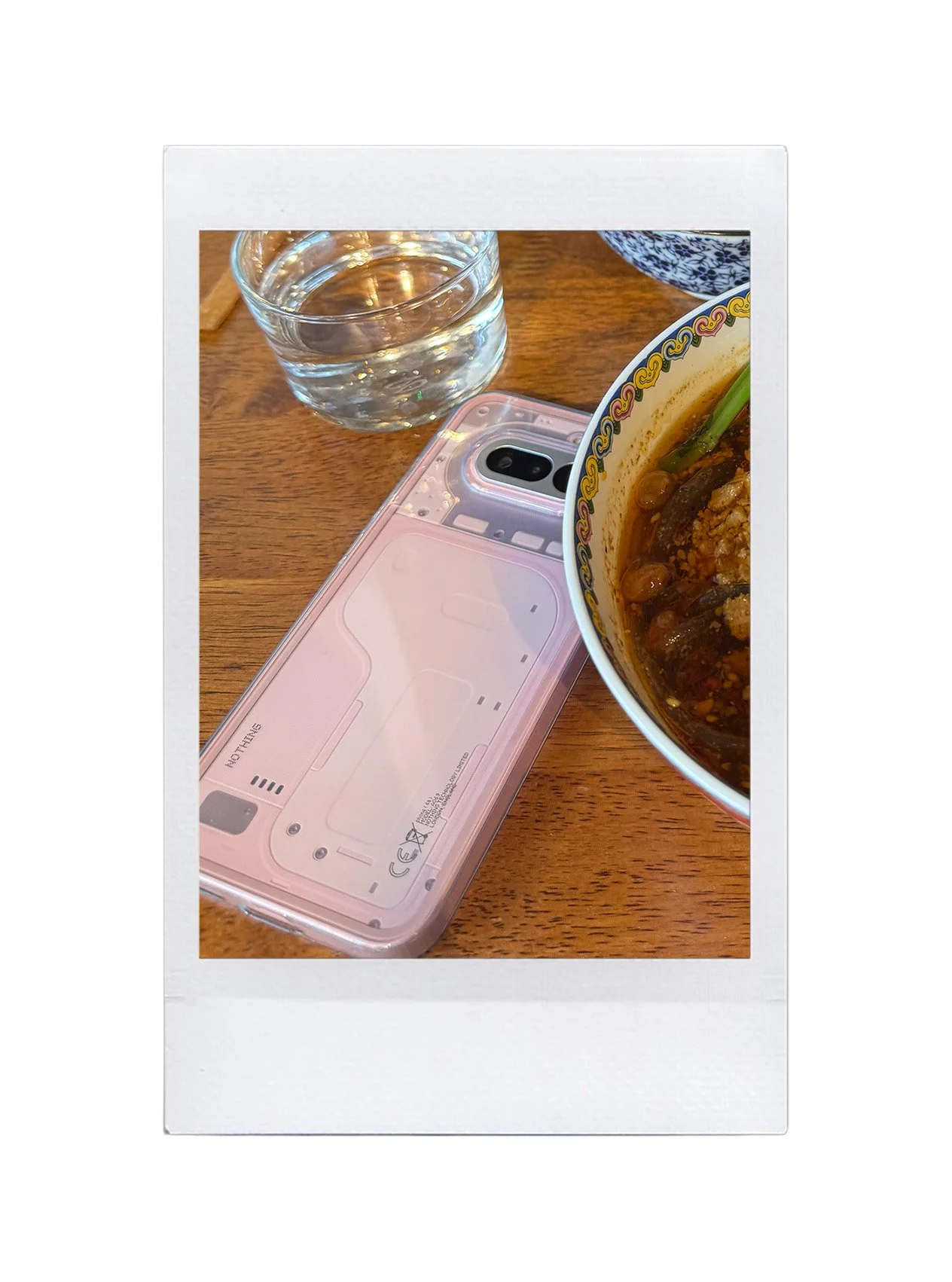
The first time I properly noticed Nothing, it was not because I had suddenly betrayed the Apple ecosystem, nor because transparent design was especially new. What drew me in was the sense of an interior that had already been organised: inside the smoky-grey earbud case, the buds, short stems, red-and-white markings and dot-matrix graphics each occupied a clearly defined position; on the back of the pink phone, screws, compartments, the camera island and light strips were visible without every component being fully exposed. It looked less like a machine taken apart than an edited engineering drawing.
At the time, I was surrounded by a new kind of information anxiety. The notes in my bookmarks kept multiplying. AI tutorials, agents, automated workflows and new ways of programming appeared every day. Skills that had once required long periods of accumulation were suddenly being compressed into buttons and prompts. The more I saved, the less it felt like learning. It felt instead as though I were afraid of missing the one new method capable of making everything I already knew obsolete.
It was also around then that I began to notice how many transparent objects had entered my surroundings: MUJI storage boxes, clear coasters, glass pour-over cups, and later Nothing’s earbuds and my work phone. They did not actually help me understand technology, nor did they make complex systems simple, but they offered a brief sense of legibility. At least on the surfaces of these objects, structure had not disappeared completely. Lines, screws, divisions and lights still suggested that what lay inside was not inaccessible, only arranged into a form I could read.
This transparency was not exposure. Nothing did not reveal every battery, cable and chip without selection. It decided what should be visible, what should remain covered, what should become a line, and what should survive only as a light or a colour. What it offered was not the complete truth, but a kind of edited honesty. The complexity remained; it had simply been laid out in a way that no longer felt suffocating.
I liked this approach, and I also liked being able to recognise its design language. It was quieter than a direct logo, though not necessarily more innocent. It was still a form of display, only one that shifted the emphasis from price to recognition. You had to understand the screws, compartments and translucent casing before realising that this was not an ordinary phone back. It was a low-volume form of display: distinctive enough to be noticed, but without needing to explain itself to everyone.
Yet I soon realised that I could accept this transparency only in certain objects. My personal phone and computer still had to be black, preferably a solid black without unnecessary decoration. At first, this preference seemed like little more than an aesthetic habit. Black was difficult to get wrong, it worked with the colours in my wardrobe, and it did not become dated when the device itself did. But when the pink Nothing Phone became my work phone, the distinction suddenly became clearer.
The pink phone carries the part of me that faces outwards. It contains work contacts, projects, files and matters that require timely replies. Its colour is conspicuous enough, and unlike my other devices enough, that picking it up feels like entering a defined role. This is the place where things can be organised, contacted and kept legible. It does not need to contain all of me. It only needs to hold the version that can act, reply, arrange and solve.
The black devices carry a different kind of content. They hold notes that have not yet been organised, articles left half-written, judgements that are too private, projects that have not yet taken shape, and sentences written late at night that I have no intention of explaining to anyone. They are private not because the content is necessarily secret, but because it has not yet become a version ready to be read by somebody else.
Were these things housed inside machines that felt excessively transparent or outward-facing, I would not experience that as honesty, but as a mismatch of roles. The casing would not, of course, reveal the files inside, yet an object still affects how I understand my relationship with it. The pink translucent phone feels like an outward-facing interface; the black computer is more like a closed door. One reminds me to enter work. The other allows me to remain where I am before I have an answer.
I used to think of black as the safe choice, perhaps even a slightly lazy one. It is almost always available, requires no fresh decision and does not ask me to risk choosing the wrong colour. But I am now more willing to admit that its sense of safety does not come only from being easy to match. Black is in no hurry to display an interior, nor does it actively invite anyone to understand it. It leaves the object with an unexplained surface, and I need that surface.
This does not mean that I am opposed to transparency. The translucent earbuds and the pink work phone still give me pleasure. They arrange complexity into a readable structure and draw clear boundaries around particular roles. The difficulty is that we are quick to mistake legibility for honesty, and then honesty for a universal virtue, as though anything made sufficiently transparent must also become more trustworthy, more modern and more worthy of closeness.
But not everything needs to be organised into a form suitable for display. Before becoming an article, an idea may remain only a set of confused fragments. A person does not need to translate every emotion, motive and contradiction into language that others can easily understand. Privacy is not the same as suspicion, and opacity is not the same as avoidance. Sometimes, not being immediately legible is precisely what allows something to continue growing.
My work phone can be pink and translucent, like a carefully laid-out technical interface. It is responsible for action, and for being seen. My personal devices remain black, quietly containing the parts that have not yet decided whether they will ever become public.
Transparent objects make me feel that there are still structures in the world that can be read. Black keeps what I am not yet ready to hand over.
