
The Trousers That Did Not Make Me Look Better
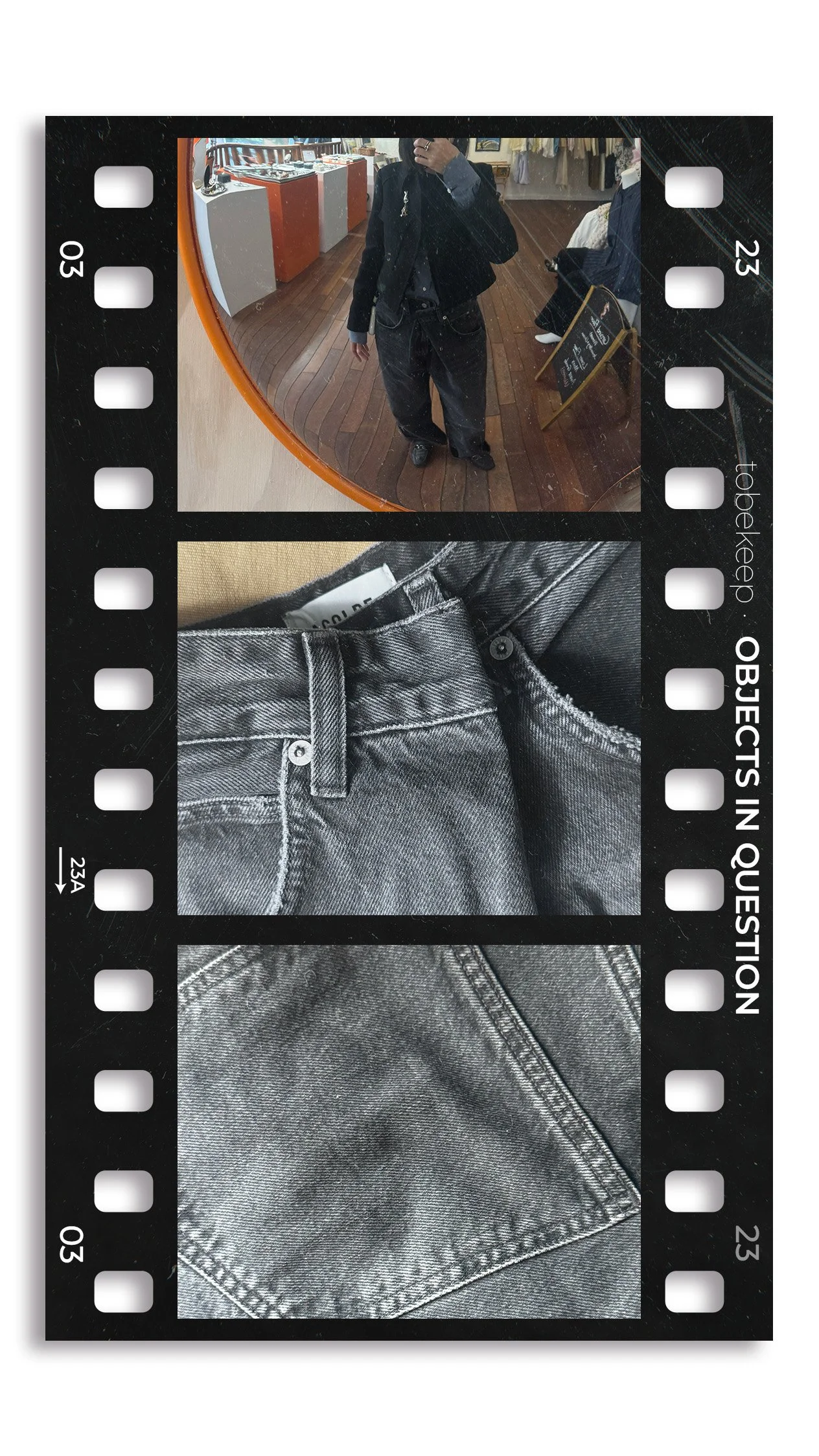
How two pairs of jeans distinguished clothes that suit an image from clothes that suit a body.
Objects: Black wrap jeans · Blue double-waist jeans
Filed under: Clothing · Image · Embodiment · Self-recognition
The black jeans were never in my shopping wish list. They were an extra, deliberately added from among the website’s assorted offerings so that my order would qualify for free delivery. The pair I had been thinking about for weeks was something else entirely: blue washed denim, a loose straight leg, a slightly oversized menswear cut, and a waistband constructed in two layers.
What attracted me most was the way the upper layer could be left open and folded down like a loosened collar. The waistband beneath sat low enough to reveal the band of a pair of underwear.
I knew, of course, that this was an imagined version of myself. A visible waistband still carries a residue of 1990s street rebellion: loose, lazy and seemingly unwilling to be disciplined by clothes. For me now, it offered a slightly different temptation. I was not trying to return to being young. I wanted to borrow, briefly, the posture of someone who did not care what anyone thought.
In my imagination, I looked very cool.
In reality, I went to Selfridges first to try the jeans on for size. My usual size 8 fastened, but it did not fit comfortably. The higher of the two waistbands only just buttoned, and the legs did not have the looseness I had imagined. The denim was already heavy; once it sat close to the body, the visual generosity of the cut did not translate into physical ease.
In the next size up, the upper waistband fitted, but the lower one needed a belt. At least the jeans now came closer to the picture in my head: lower, looser, with a little waistband showing, not entirely obedient. The appearance of ease and the actual sensation of wearing them were finally less at odds.
I went home and ordered the larger size. Before I paid, the website reminded me that I was still slightly short of free delivery. Irritated by the idea of paying for postage when I could put that money towards something else, I kept scrolling. That was when the black jeans appeared.
They also had a loose, straight leg, with one side of the waistband folded across the other in a wrap construction. They were asymmetric and casual, but with a little character of their own. Black denim was also almost absent from my wardrobe. I chose my usual size and added them to the basket, without seriously expecting to keep them.
They were simply the pair I checked out with the jeans I actually wanted.
A few days later, both arrived. The blue double-waist jeans brought no surprise. They felt exactly as they had in Selfridges: slightly effortful, slightly cumbersome, and slightly dependent on my willingness to accommodate them.
Then I put on the black pair.
I knew almost immediately that I would keep them. What won me over was not entirely the asymmetric fold at the waist. The design was distinctive, but not so distinctive that I needed it for that reason alone. What mattered was the feeling they produced once they touched the skin: I did not have to prove anything, and I did not have to make a deliberate effort to become someone. I was simply wearing them. I did not even feel an immediate need to define what kind of person that made me.
They also had pockets so large they were almost excessive. I tried putting everything I normally needed for going out into them: tissues, wallet, phone and portable charger. Then I realised I could leave home without a bag.
This mattered more than I expected.
A bag often implies preparation, care, contingency and backup plans. Pockets are different. They absorb those things into the clothes themselves, allowing the body to leave directly. My hands had somewhere to go; so did my phone and tissues. The jeans did not merely hold my belongings. They held a kind of ease in which I did not have to prepare an additional version of myself before going out.
They did not require my body to remain vigilant either. I did not need to check whether my stomach protruded after eating, worry about how the flesh of my inner thighs moved as I walked, or arrange my shirt so that it was open by exactly the right amount—sexy, but not too sexy. I could leave two or three buttons undone naturally, with an unpadded, unwired bra underneath. My upper body could look flatter. My body could even resemble a rectangle.
I did not feel less feminine because of it.
The more often I wore the black jeans out to meet people, the more I began to reconsider the blue pair. What attracted me to them was sexy, but it was also deliberate. They were attached to an image that felt somehow inaccessible to me: Calvin Klein underwear adverts, low-rise jeans, a visible waistband, a young body, and the kind of languor that has been carefully designed to look as though it does not care.
The jeans themselves were very complete. They were not merely a pair of trousers, but something closer to an image that had already been photographed, complete with a built-in gesture. The problem was that a body does not automatically enter the image.
I had already known this in the Selfridges fitting room; I simply had not been ready to admit it. My torso is not long, and concentrating so much design around the waist compressed the visual centre of my body. It also competed with whatever I wore above it. With a shirt, the two waistbands, buttons, layers of denim and the line of my chest all gathered in the middle.
That was not ease.
It was a highly articulate design asking my body to finish the sentence for it.
The black jeans did the opposite. Their fold began below the navel and drew the eye downwards. They did not concentrate all their attention at my waist or ask me to expose anything. They were simply loose, long and black, with one side crossing over the other. My hands slipped easily into the pockets, the hems pooled over my shoes, my shirt could remain open, and my stomach could simply be a stomach.
A pair of trousers might be beautiful, but if it prevents my hands from resting naturally in the pockets, or keeps my body working to maintain a particular image, it no longer suits the state I am in now.
This was not a sudden decision that I no longer wanted to be sexy. On the contrary, the black jeans made me consider seriously, perhaps for the first time, who had been defining sexiness for me.
Looking back, much of what I thought I understood as sexy came with a ready-made script. These scripts were not ineffective. Quite the opposite: they worked so efficiently that they hardly needed explaining. Other people already knew how to read them. Yet that was also why they sometimes felt less like my body than like a role that had already been written.
I had this thought while wearing the black jeans with a grey shirt. Three buttons were undone without much calculation, the hem was loosely tucked into the waistband, and I had flat shoes on.
There was almost nothing conventionally sexy about the outfit. It did not emphasise curves, expose much skin, or direct separate attention towards the chest, waist and legs. It could even be said to make me look a little rectangular.
But standing there, I genuinely felt sexy.
Not because I looked more like an already recognised image of sexiness, but because I felt comfortable and at ease. My body was not being hurried by my clothes to prove anything. My shirt could stay open, my stomach could exist, my legs could move inside loose fabric, and my hands could remain in my pockets. I even felt that I might be slightly funnier when I spoke.
This may be the kind of sexiness I trust more now: not something instantly legible, but the state in which the body no longer has to keep adjusting itself.
The blue double-waist jeans were still beautiful. The design was complete and belonged convincingly to a particular image of sexiness, perhaps even to a particular script. I would not deny that form of sexiness. It has every reason to exist. It can still attract me and make me want to step into the story it already carries.
But I now know where it comes from.
When I do not feel that it belongs to me, being recognised by someone else does not make it mine. It is only borrowed sexiness.
The blue pair suited the image.
The black pair suited the body.
