

Observation Room
Decoding the invisible scripts behind our visible choices.
The world moves faster than our ability to process it.
The Observation Room is a dedicated space for stillness. Here, we step off the algorithmic treadmill to conduct forensic audits on the culture we inhabit. From the economics of a viral grocery bag to the psychology of a vinyl monster, we dissect not just what is selling, but why we are buying.
We watch the noise to find the signal.
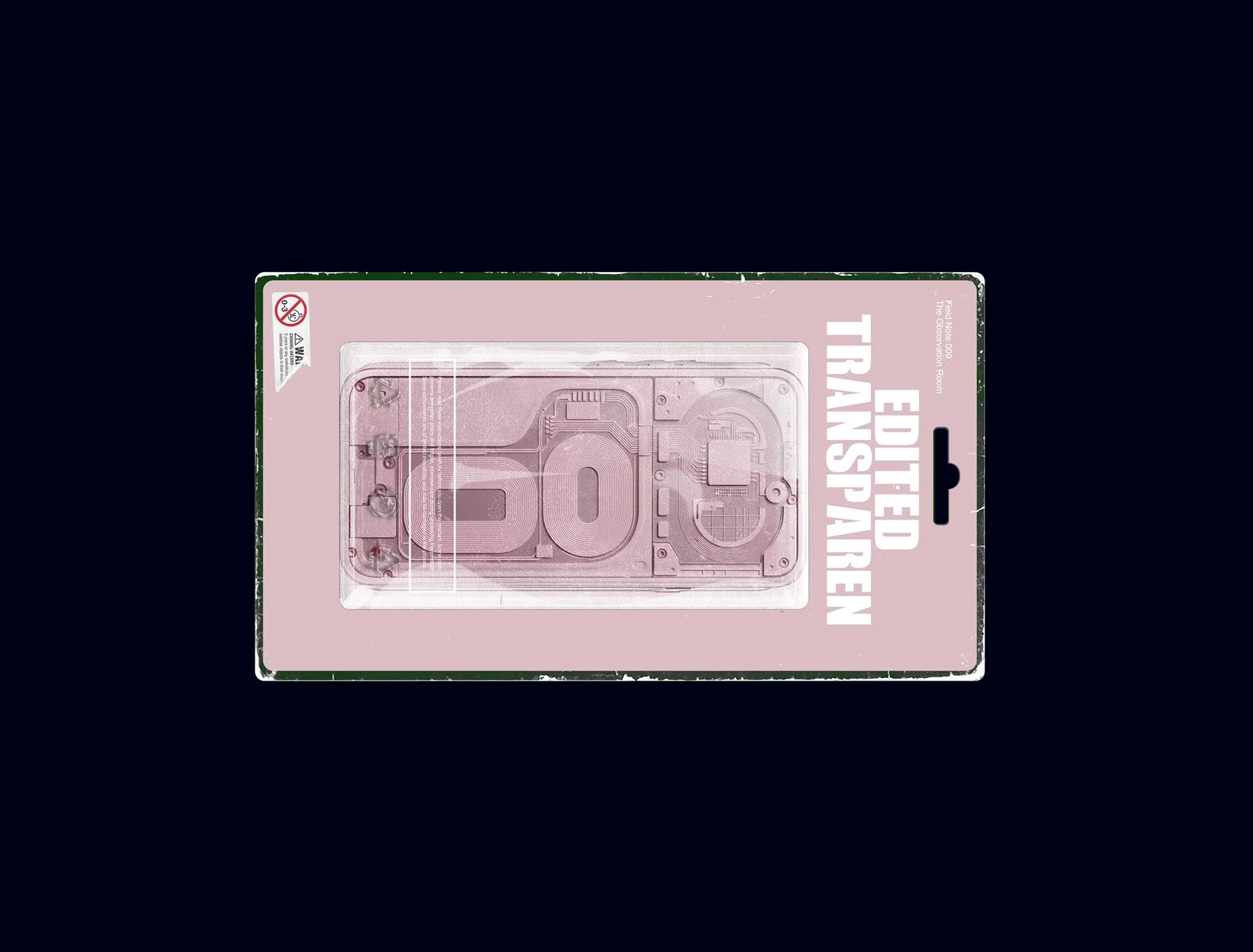
Keeping black in a black-box age
As AI agents and algorithmic fog make reality feel increasingly uncontrollable, our fascination with “transparent objects” may not be a purely aesthetic preference. It may be a small act of psychological compensation.
But this kind of transparency is not total exposure.
Nothing’s earphones and phones do not lay every battery, cable and chip bare in front of us. What they offer is a designed form of semi-transparent legibility: clear casing, visible screws, modular divisions, Glyph lighting, red indicator points, and surface cues arranged like a softened engineering drawing.
We stare at these structures not because we truly understand the technology, but because they briefly let us believe that we can still read the age we are living in.
And yet, I still need my personal phone and computer to be black. Not because black is cooler, though it usually is, but because some parts of the self should not be displayed, explained, dismantled or optimised.
Transparency gives me order.
Black gives me boundaries.