
Keeping black in a black-box age
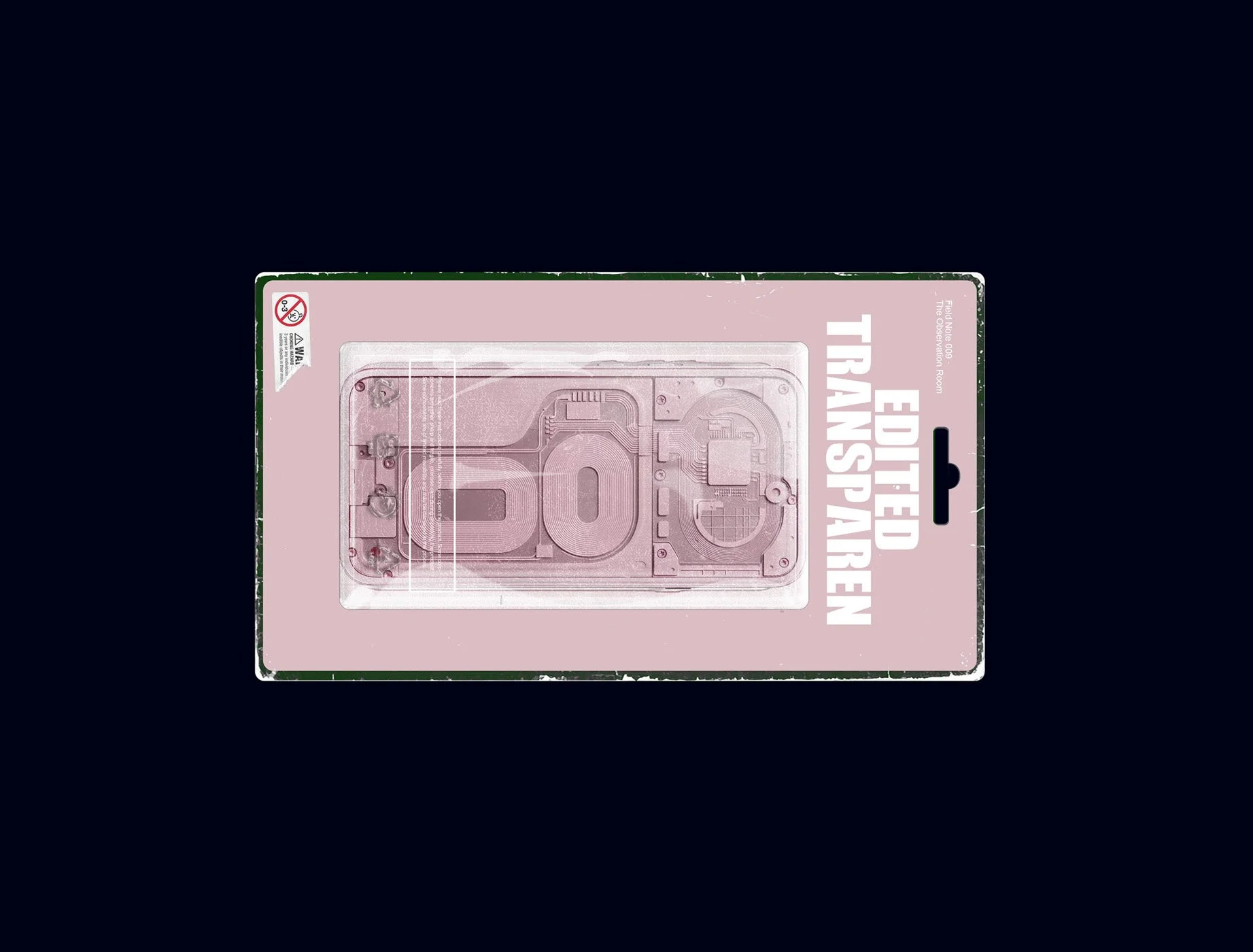
Transparent shells, AI anxiety, and the last opaque self
Section: The Case Study
Date:07 May 2026
Filed under: Technology philosophy / Object psychology / Personal archive
The Brief
As AI agents and algorithmic fog make reality feel increasingly uncontrollable, our fascination with “transparent objects” may not be a purely aesthetic preference. It may be a small act of psychological compensation.
But this kind of transparency is not total exposure.
Nothing’s earphones and phones do not lay every battery, cable and chip bare in front of us. What they offer is a designed form of semi-transparent legibility: clear casing, visible screws, modular divisions, Glyph lighting, red indicator points, and surface cues arranged like a softened engineering drawing.
We stare at these structures not because we truly understand the technology, but because they briefly let us believe that we can still read the age we are living in.
And yet, I still need my personal phone and computer to be black. Not because black is cooler, though it usually is, but because some parts of the self should not be displayed, explained, dismantled or optimised.
Transparency gives me order.
Black gives me boundaries.
01. A flare in the algorithmic fog
In an age obsessed with seamlessness, Apple pursues joints so precise they almost disappear. Yoga leggings chase invisible seams. Interfaces attempt to erase every trace of the technology underneath.
And then I found myself unexpectedly struck by Nothing’s technical layout.
Which is counterintuitive.
As someone long accustomed to the Apple ecosystem, I have felt a new kind of information anxiety in 2026, now that AI has seeped into almost everything. The tens of thousands of notes in my archive, the endless AI tutorials, the agents, the vibe coding, the automation workflows. They look like the victory of curiosity. In truth, they feel more like the hoarding behaviour of someone quietly afraid of being replaced.
Skills that once felt hard-won are suddenly being compressed into buttons, templates and prompts. Technology has not disappeared. It has simply become a cheap inflationary currency.
This unease is not just my private neurosis wearing a nice coat. Vogue Business’s 2026 AI consumer perception survey observed a similar contradiction: consumers are not entirely resistant to AI, but they remain highly cautious about recommendations, data, privacy and control. In particular, only 31 per cent of respondents said they would outsource shopping to an AI agent, even if it knew their taste and purchase history.
In other words, we do not hate efficiency.
We fear efficiency crossing the boundary on our behalf.
It was around this time that I began noticing my own strangely specific shopping impulses.
Transparent objects started gathering around me: MUJI bottles, clear coasters, transparent pour-over coffee cups, and eventually a pair of black Nothing ear (a) earphones and a pink Nothing Phone (4a).
These transparent and semi-transparent objects felt like flares in the algorithmic fog.
They do not truly explain the world. But for a moment, they give me the sensation that at least something can still be seen.
The black ear (a) case looks like a smoky miniature display cabinet. The earbuds, chambers, stems, dot-matrix logo, red and white markings are neatly staged inside a semi-transparent container. It does not really dissect the technology. It simply lets me see a posture of internal organisation.
The pink Nothing Phone (4a) works in the same way. It is not a fully transparent phone, but a semi-transparent technical stage set: visible screws, panel divisions, camera island, Glyph bar, red recording light, and a sense of inner structure softened by pink glass, resin and metallic layers. Dezeen’s report on the Phone (4a) also notes that it continues Nothing’s design language of transparent casing, visible screws and the Glyph interface. The design team is not indiscriminately exposing every internal component, but showing real parts “as much as reasonably possible”, while using cover panel design to convey the structure underneath.
This is not complete understanding.
It is the visual summary of understanding.
But in a black-box society, that small amount of “I can see this” is enough to produce physical relief.
Transparency is not seeing through everything.
Transparency is being allowed to read a little.
02. The expensive rhetoric of “honesty”
Transparency does not mean nakedness.
In fact, Nothing’s transparency is an expensive rhetorical device.
It does not show you every part. It reorganises the visible and the hidden into a believable surface. Screws may be exposed. Module boundaries may be exposed. Glyph lights may be exposed. Certain cover panels, however, must remain politely silent.
This is not deception.
This is editorial control in industrial design.
A magazine does not publish every interview recording word for word. Nothing does not display every internal structure without discrimination. What it offers is edited truth: engineered enough, orderly enough, and distinct enough for those who understand the visual code to realise that this is not an ordinary phone back.
Nothing’s “honesty”, then, is not total transparency. It is the admission that technology is complex, but complexity can still be typeset.
This technical layout is the material form of an honesty cost.
To make the world beneath a semi-transparent shell look clean, designers have to decide what can be exposed, what must be covered, what becomes a line, what becomes light, and what can only exist as a hint.
This is not simple transparency.
This is edited honesty.
And that is precisely how it creates an IYKYK connection.
If it were truly transparent, it would become a technical display cabinet: too literal, too eager, a little bit like someone explaining blockchain at a dinner table. Nothing’s cleverness lies in revealing just enough structural cues to be recognised.
The smoky ear (a) looks like a small X-ray storage box.
The pink Phone (4a) looks like an engineering drawing that has been softened.
They are not saying, “Look how complicated I am.”
They are asking, “Do you know how to read this?”
That is the real mechanism of IYKYK. It is not the display of ownership. It is the display of literacy.
Of course, this is not purer than a logo.
It simply moves the flex from price tag to recognition threshold. Transparency is not anti-consumerism. It is quieter, more technical, and frankly better dressed for the contemporary consumer psyche.
Especially in London, a city that cares about aesthetics while also making one cautious about visible wealth, a pair of black transparent earphones or a pink semi-transparent phone offers a subtler balance than an expensive bag screaming for attention on the Central line. Brave choice, wrong carriage.
It is distinctive enough.
But not excessively exposed.
It can be seen.
But it is not begging to be noticed by everyone.
This is low-volume exhibitionism.
Possibly the only kind of exhibitionism I can tolerate.
03. Safety in the black abyss
And yet, I still cannot accept a transparent personal phone or computer.
They have to be solid black.
Phones and computers are no longer simple tools. They are my external brain, carrying odd little projects, raw drafts, unfinished ideas, half-formed business plans, and paragraphs written late at night that I do not want anyone to see, least of all the version of me who wrote them.
If these things were placed inside a transparent container, it would no longer feel honest. It would feel invasive.
It feels similar to the shock of certain perfumes.
Some scents are not invitations. They are trespassers. They arrive without permission, cross the boundary, and decide what today’s air should smell like. That kind of intrusion makes me frown, not swoon.
Transparent devices pose a similar danger to my private world.
They disguise being seen as honesty, and legibility as openness. But I do not want everything to be legible.
More than displaying myself, I prefer to hide the real self inside black.
Black is almost always available as an option. It rarely goes wrong. It does not produce awkward colour mismatches. It works with nearly everything in my wardrobe. It does not explain itself, and it does not ask to be understood.
That kind of safety is especially suited to facing one’s own shadow.
Not everything needs to glow.
Some things need to be sealed.
This instinct for black is, in fact, a form of boundary setting.
It is not boring.
It is a refusal to be translated.
04. The pink work phone and the colour firewall
The pink Nothing Phone (4a) I recently bought has become the only exception in my otherwise black world.
It is not my private abyss. It is my work phone.
That pink is not sweet in the ordinary sense. It feels more like a diluted red signal laid over a semi-transparent technical skeleton. Nothing positions pink as a more expressive and optimistic technology language, rather than a neutral safe colour; the brand also frames it not as just another colourway, but as a recognition of the role that art, music, fashion and pop culture play in shaping its design language.
That works for me.
It is outward-facing enough, incongruous enough, and unlike my personal devices enough. Its presence reminds me: this is work. This is the external persona. This is the part that can be organised, displayed and contacted.
It is not my diary.
It is my colour firewall.
Through visual friction, this “wrong” pink forcibly cuts the confusion between roles. It tells me that this machine is not for sinking into the depths. It is not for storing shadows. It is not for opening unnamed documents at two in the morning.
It is the entrance to the outside world.
It is an interface for action.
It is the typeset version of me.
It displays logic, efficiency, projects, contactability and movement.
But it is still armour.
It is not exposure.
It is organised transparency.
I hand this organised transparency to work, to offset information anxiety and to remind myself: this is work, not the whole of me.
The solid black machine remains with the abyss.
It is my last private save point.
Absolutely opaque.
Absolutely not available for explanation.
05. Transparency is not nakedness. Black is not escape.
Transparency is not about handing everything over.
It simply lets me confirm that certain structures can still be read.
Black is not escape either.
It is the last room I keep for myself.
In an age that constantly asks us to display, synchronise, optimise and be understood, real freedom may not mean becoming fully transparent. It may mean knowing where one can be seen, and where one must remain dark.
Transparent objects give me a temporary sense of order.
Black devices remind me that I do not need to translate myself entirely for the world.
This is not a contradiction.
It is a seesaw.
At one end: the desire for legibility.
At the other: the insistence on boundaries.
And somewhere between the two, I am practising a more precise form of self-preservation.
The Takeaway / The Verdict
Keep:
edited transparency.
Transparent objects can stay, but they should not be mistaken for truth. What makes Nothing compelling is not that it lets us see through everything, but that it offers bounded legibility: screws, divisions, lights and semi-transparent casing arranged like a technical summary. Its value lies in calibrating anxiety, not curing it.Let go:
the obsession with seeing through everything.
Transparency can feel satisfying, but it does not offer real control. The more black-boxed the age becomes, the more tempting it is to believe that “I want to understand everything” is a reasonable demand. Some systems will never fully unfold for us. Some parts of the self should not be dismantled just to feel safe.Look elsewhere:
black boundaries.
When an object carries private documents, accounts, projects, late-night drafts and unnamed shadows, the answer is not transparency but opacity. A work phone can be pink, semi-transparent and legible. A private device should remain solid black. Not escape, but a save point. Not boredom, but sovereignty.
R.tobekeep
