
Name It To Kill It: Why Emotional Intelligence is Becoming Emotional Euthanasia
Why Emotional Intelligence is Becoming Emotional Euthanasia
Section: The Case Study
Date:28 January 2026
Filed under: The Observation Room / Internal Colonialism / The Death of Experientiality
The Brief
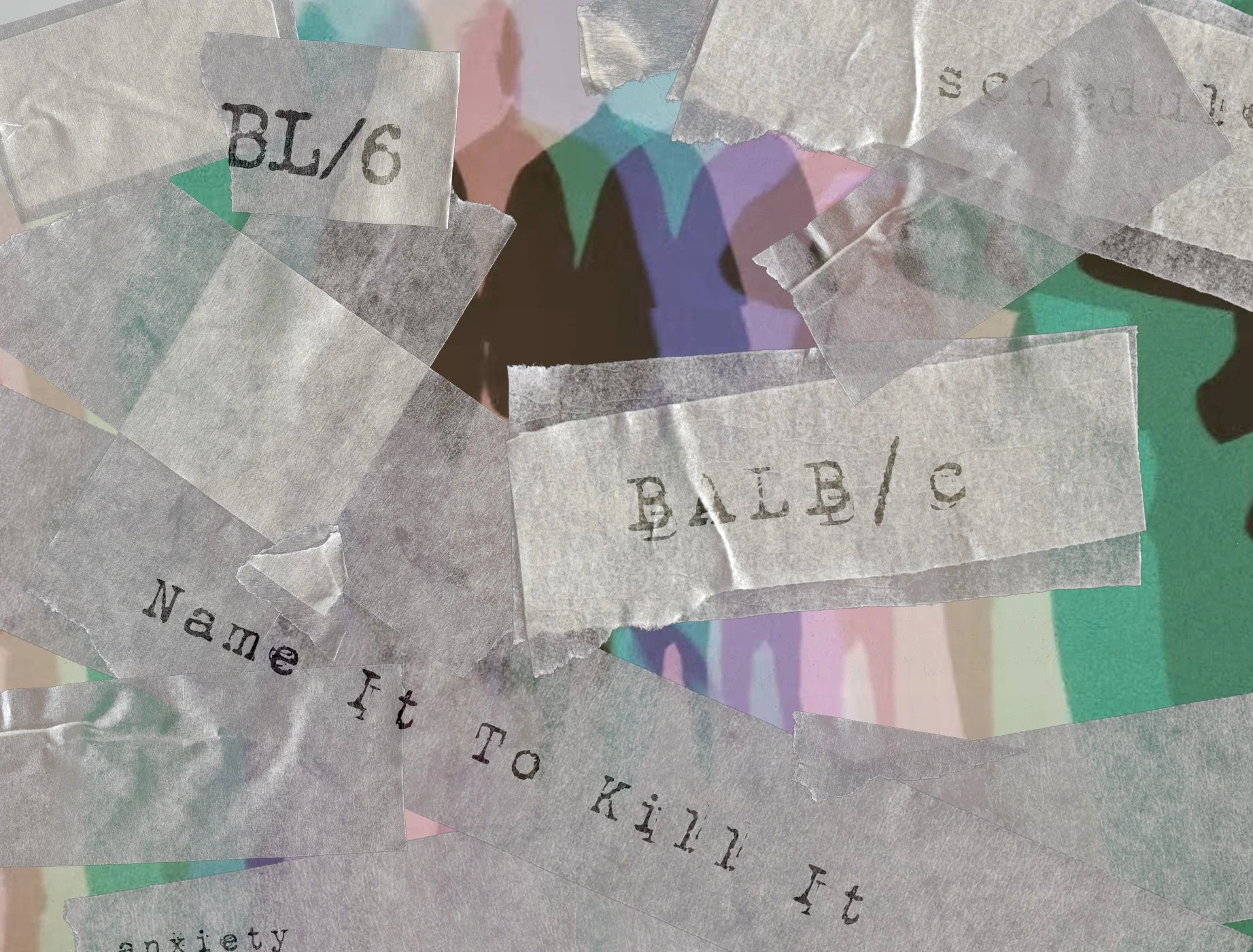
We live in an age obsessed with "emotional management." Algorithms and pop psychology peddle a promise: as long as we can label our pain ("Name it"), we can tame it ("Tame it"). But this audit proposes a dissent: this seemingly scientific "intellectualisation" is actually a brutal form of "Internal Colonialism." The way we treat our emotions bears a chilling resemblance to how laboratories treat lab rats—scientists create distance by stripping away names, while we create distance by affixing pathological labels (another form of numbering). Neither is for understanding; both are for executing a highly efficient, hygienic, and painless "emotional euthanasia."
01. The Evidence: A Law of Silence
It all started on a slightly tipsy Sunday afternoon. At a sharing session titled "Human Fertility and Choice through the Lens of Animal Testing," a researcher studying cancer and infertility described the life cycle of lab rats to us. During the Q&A, someone asked, "Do you really not give the rats names?" I followed up: "Do you have any rituals when you euthanise them?"
He shook his head, offering a reason that was pragmatic, perhaps even professionally flat: "Generally, no. First, because the numbers are too vast; second, for the sake of data tracking and genealogy records, numbering is more precise than naming."
He paused, his voice lowering slightly: "And, to be honest, it also makes us feel a bit better psychologically. After all, their end is usually Schedule 1—the official protocol for euthanasia."
"Feel a bit better." I understood the logic behind this: A name is a bridge. Once you give it a name, it is no longer a data point; it becomes a life with Subjectivity. When you must personally euthanise a nameless "Number 3," it is a procedure; but if you are killing "Charlie," it is a murder.
The most common method is: two fingers pinching the tail, two fingers pinching the back of the neck, a sudden pull—snap—the spine severs, consciousness vanishes. To keep those hands from shaking, to make the execution "compliant" and "painless," stripping the name becomes the necessary first step.
But in this algorithmic age, I discovered we are doing something to ourselves that is diametrically opposite, yet shares the exact same goal. Scientists refuse to name in order to turn the rat into "Number 3" (Objectification), facilitating the kill. In psychological self-help, we desperately name ("This is anxiety," "This is trauma"), surprisingly for the purpose of turning that vague pain into a "medical specimen" (Objectification).
The means are opposite, but the core logic is identical: We all want to strip "it" from our bodies so we can comfortably execute Schedule 1.
02. The Mechanism: The Medical Gaze
Let's audit our current "self-healing" process. When a vague, heavy, blood-scented discomfort strikes, what is our first reaction? We don't open a book; we grab our phones, open Google, or ask AI directly:
"My heart is racing, hands shaking, what are the symptoms?" — Algorithm answers: Amygdala Hijack.
"I'm snapping at my partner uncontrollably, why?" — Social media tells you: Attachment Injury.
"I feel extremely insecure in this relationship." — A vlogger diagnoses you: Anxious Attachment.
Foucault pointed out that the Medical Gaze views the body as an object, separating the symptom from the person. When we tell the screen "So I am the anxious type," we are engaging in Objectification. We turn the "pain" that was originally connected to flesh and blood into an external, repairable "Bug."
We are in such a rush to label emotions, not to "see" them, but to create distance. This distance makes us feel like safe observers rather than bleeding experiencers. This is a supreme defence mechanism—Intellectualisation. We use terms learned from trending searches as scalpels to cut off the emotion before it has even expired, drop it into a specimen jar, label it, and place it on a shelf to prove we are "emotionally stable."
03. The Trap: Instrumental Reason
Why do we do this? Why can't we tolerate pain existing for even a single second? Because in this achievement society, emotion is inefficient.
This is what the Frankfurt School criticised as "Instrumental Reason": everything is viewed as a means to an end. In the lab, the rat is a tool for producing data. Once the data is extracted, the rat is waste that must be cleared. In our lives, emotion is noise that hinders efficiency. Sadness affects work; anger affects socialising. So we execute Schedule 1 on ourselves—we must "euthanise" this waste.
This explains why pop psychology teaches us to "breathe deep" and "accept." This is exactly like the "Safe Handling"method in the lab. The researcher told me: "Before the execution, you must gently support the rat with your non-dominant hand to make it feel safe. Because the rat can smell your hormones. If it feels uneasy, it will struggle, and you won't be able to snap its neck cleanly. We want it to leave this world in the fastest, most instant moment, before it can react."
Our "gentleness" toward ourselves is the same. We tell ourselves "It's okay, accept yourself," not to embrace the crying child, but to Fixate it, so we can precisely inject a sedative, make it shut up quickly, and clock in on time Monday morning.
This is not facing. This is administrative cleanup. We are pursuing efficiency, not truth.
04. The Consequence: The Universe 25
If we succeed? If we really clean our inner world as spotless as a sterile lab?
The price we pay was previewed long ago in John Calhoun's "Universe 25" experiment. In a utopia where all threats, pain, and survival pressures were eliminated, the rats eventually stopped breeding, stopped socialising, and did nothing but groom their fur. They were called "The Beautiful Ones"—perfect on the outside, but spiritually dead on the inside.
This is the endgame of our "emotional hygiene." If we use "psychological knowledge" to kill all conflict, jealousy, madness, and chaos, we will become those "Beautiful Ones." We are emotionally stable, logically consistent, never out of control. But we are devitalised. We lose "Experientiality." We no longer live in life; we live in the "management" of life.
05. The Glitch: The Horoscope of the HR Age
To make this "cleanup" feel even more logical, we invented an even more advanced tool: personality labels. Look closely at our current social dialogue; psychological terminology has become a "prescription without a doctor's diagnosis."
"I don't socialise because I am an Introvert (I-type)."
"I lack boundaries because I am Anxious Attachment."
But there is a massive logical trap behind this. Take a certain MBTI test website revered by hundreds of millions (if you Google MBTI, it's always at the top). If you dig into the obscure "Core Theory" page on its English site, you will find a laughable fact: The officials explicitly admit they do not use orthodox Jungian cognitive functions (like Ni, Fe), but instead use the "Big Five" personality model repackaged into the four-letter MBTI format, simply for "simplicity and convenience."
The paradox appears: You use a test based on the "Big Five" to slap an "INTJ" label on yourself, then use "Jungian Eight Functions" theory—which you never actually tested for—to explain your behaviour. This is a "map of double dislocation."
Why are we so obsessed with these labels? Because they are the perfect "Get Out of Jail Free Card." It is a form of Lazy Determinism. When we say "I am a P-type, so I'm late," we are acting in "Bad Faith" (Sartre). We objectifyourselves into a fixed "item," thereby escaping the freedom and responsibility of being a "human" who must overcome inertia. Just like turning a rat into "Number 3," turning ourselves into "four letters" allows us to feel at peace while giving up on growth.
06. The Protocol: A Negotiation, Not an Execution
If "naming is quarantining, and processing is killing," what should we do? Here is an alternative protocol. This is not a standard answer; it is simply a sample of refusing to execute Schedule 1.
Phase 1:
The Body Witness Usually, before the brain reacts, the body knows. The chest feels tight, like a stone is pressing on it. At this moment, do not rush to name it. Do not check the dictionary. Do a Physiological Sigh (double inhale, long exhale). Not to drive the emotion away, but to supply oxygen to the brain, telling the body: "Although it hurts now, we are safe." Cache this suffocating feeling for now, and continue living.
Phase 2:
The Walking Container Find a time (like a lunch break) to go to a park, or walk on a street with no destination.Take off your headphones. This is important. Observe yourself: how long has it been since your ears were in a "vacuum"? No podcasts, no music, no white noise. In this physical "Breathing Room," let that emotion walk with you like a friend who doesn't want to talk. Relax your brain, observe the pedestrians, until that voice emerges on its own.
Phase 3:
The Negotiation When it finally speaks (perhaps anger, perhaps grievance), do not use "Cognitive Reframing" to educate it. Trace the source. "Is it because of that sentence just now? Or did that sentence remind you of childhood?" Treat it like a wronged but reasonable child, and negotiate with it. Listen to its accusations, lay out the facts, explain the misunderstanding, until a consensus is reached.
Only when the inner child is convinced and willing to lay down their weapon will the stone on the chest truly disappear.This is not "covering with a white cloth and cremating"; this is "reaching a reconciliation."
Sound useless? Maybe you can start with the simplest step: Take off your headphones. Walk on the road, look at the scenery, observe the pedestrians. When your ears are no longer filled with voices recommended by algorithms, the inner voice has a chance to surface.
Of course, this is my method. You should find your own.
The Takeaway
Keep: Independent Audit When the algorithm pushes tons of "psychological advice" in front of you, remain vigilant. Do not assume it is suitable for you just because it looks authoritative and popular. It might just be the "placebo most comforting to modern people" calculated by big data.
Let Go: The Labels Do not treat MBTI or attachment styles as your "Factory Settings." Labels are starting points for understanding yourself, not endpoints to box yourself in. Nor should they be used as excuses for hurting others or evading responsibility.
Look Elsewhere: Go find that place that can contain your chaos. Maybe it is not in a psychology book, but in a walk with no purpose and no headphones. Do not execute Schedule 1.
Pain is the proof that you have not yet become one of "The Beautiful Ones."
R. tobekeep
