The Fast-Fashion Engine: How Speed Industrialises Time
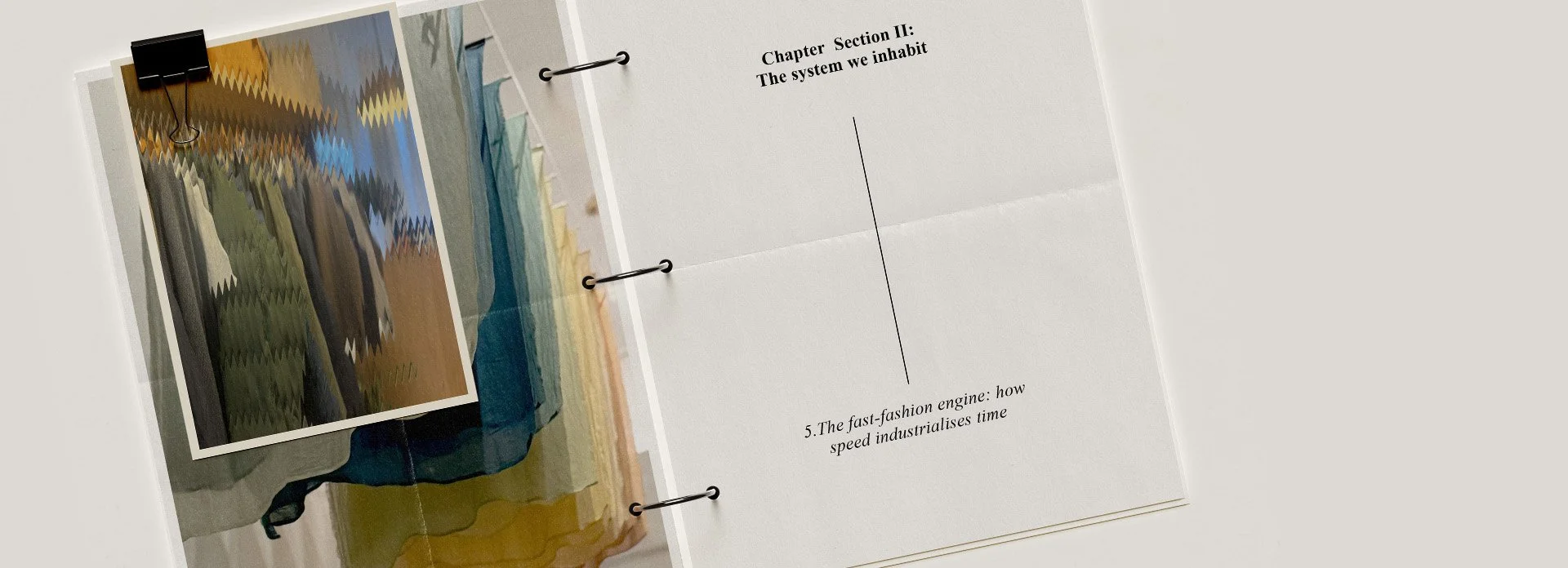
Section II: The System We Inhabit
Date: 22 January 2026 (Original data: 2018)
Filed under: The Archive / Look, Not Logo
The Brief
Fast fashion did not invent copying. It industrialised time. By shrinking the cycle from runway to reality down to mere weeks, the industry has fundamentally reshaped our patience. To understand the engine is to see the invisible currents that shape our sense of "now." It trains us to treat clothing not as durable goods, but as perishable data.
1. The Architecture of the Engine
How does a trend move from a sketch to your feed in 14 days? It is not magic; it is an agile supply chain optimised for Zero Latency.
Step 1: Signal Scraping The engine constantly scans for inputs. Trend forecasters, runway shows, street style, and TikTok virality collapse into one blended dataset. It doesn't wait for "Seasons"; it waits for "Spikes" in attention.
Step 2: Rapid Interpretation (The Remix) Design teams distil the look, not the logo. They shift details just enough to avoid trade mark infringement (see Article 1) but keep the silhouette recognizable.
Step 3: The MVP (Micro-Drops) Instead of manufacturing 100,000 units, the engine runs a small batch (an MVP - Minimum Viable Product). This is a test flight.
Step 4: The Data Feedback Loop Real-time sales data dictates the next move.
If it sells: The factory scales up production immediately.
If it sits: The design is killed, and the fabric is repurposed.
Result: Constant novelty replaces seasonal rhythm. It nudges us to shop the way we scroll: continuously.
2. The Psychological Output
What does this machine do to the user? It rewires our expectations.
The Death of Anticipation Waiting six months for a coat now feels like a system error. When an interpretation is available this weekend, patience feels irrational. We have been programmed to prefer the "Good Enough, Now" over the "Perfect, Later."
Normalised Prototyping Because the cost is low and the speed is high, buying a dupe to "test" a silhouette becomes sensible rather than suspect. We treat clothes like disposable razors.
Inflation of Uniqueness As looks flood the feed, the "Uniqueness" of a design depreciates rapidly. By the time the original luxury item hits the boutique, the High Street version has already been worn, posted, and discarded.
3. The Ethics of Velocity
Speed acts as an anesthetic. The faster the cycle, the less we examine the "glitches" in the system: the underpaid labour, the synthetic materials, and the end-of-life waste. When you buy at speed, you are often agreeing to terms and conditions you haven't read.
4. Tactical Audit: The "Wind Tunnel" Strategy
So, how do we use this engine without being consumed by it? Treat Fast Fashion like a Wind Tunnel.
In aerodynamics, a wind tunnel is a place where you test a shape to see how it performs before you build the real plane.
Use the Engine: Use affordable, fast pieces to run quick trials. Test a new colour or a daring cut.
The Exit: Once the test is complete, leave the tunnel.
The Rule: If a look passes your 14-wear threshold (it works, it fits, you love it), stop buying the cheap versions. Buy the well-made, durable version.
Don't live in the wind tunnel. It is loud, chaotic, and built for testing, not for dwelling.
Takeaway
Keep: Using speed for learning (prototyping), not for hoarding.
Let Go: The idea that "New" equals "Necessary." Novelty is a teacher, not a destiny.
Look Elsewhere: We examine the legal lines of this system in When Stripes Become Trademarks (Article 6).
-
0.Preface: The Return of Sight
A 14-part audit of the scripts behind our purchases.
1.Knock-offs vs counterfeits: the plain-English line
A clean definition that stops "dupe" from fogging the legal reality.2.Money is the First Gate: The Economics of a Look
Price is a filter, not a verdict. Here is how to read it without snobbery.3.The field guide: original, dupe, or nothing
A practical test for your eye, before you commit to the cart. -
4.A short history of copying: from couture salons to TikTok feeds
Copying did not start online. It just got rewarded there.5.The fast-fashion engine: how speed industrialises time
Speed is the product. Clothing is the by-product.6.When stripes become trade marks: where style trespasses into source
The moment design becomes identity, and identity becomes a boundary. -
7.Emotions in the fitting room: guilt, pride, and the compliment effect
The mirror is emotional. The purchase follows the feeling.8.The buyer archetypes: a map of five inner logics
Five purchase motives, five stories we tell ourselves.9.Platforms and pressure: how feeds script our taste
Your taste is not pure. It is edited in public.10.Reading Quiet Luxury (Part I): cut, cloth, and composition
Quiet Luxury begins in construction, not a colour palette.11.Reading Quiet Luxury (Part II): the old-money filter
A status aesthetic that hides its own loudness.12.The minimalist’s paradox: when owning less becomes its own excess
Minimalism can become a costume. Let us make it a choice. -
13.What dupes do to brands: acceleration, substitution, and overexposure
Dupes do not only copy products. They copy attention.14.How we listened: the 13 interviews behind the insights
The method, the voices, and what people meant off-script.15.Limits, bias, and your next steps: the final action sheet
What this series cannot prove, and what you can do.